Category:
Posted on November 24, 2024
Imagine this scenario: A parent comes to you during your OSCE and asks,
"Doctor, are these 8-week vaccines really necessary for my baby? I’m worried about side effects."
How do you respond systematically while showcasing clinical competence, empathy, and excellent communication skills?
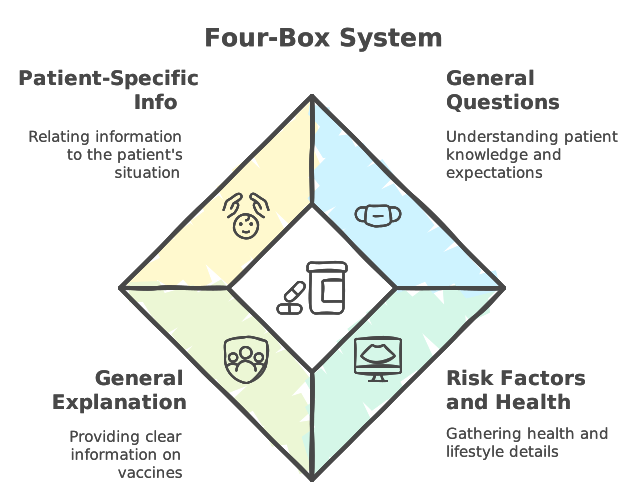
This is where the Four-Box System becomes your ally. This structured framework ensures you gather information, address patient concerns, and provide personalized advice—all essential for excelling in the PLAB 2 OSCE and real-world clinical practice.
In this blog, we’ll explore the Four-Box System, its steps, and how it applies to various PLAB 2 OSCE scenarios. Whether you're tackling vaccine counseling, handling end-of-life decisions, or navigating patient confidentiality, this guide will help you confidently apply the method to ethical and clinical consultations.
The Four-Box System, developed by Jonsen, Siegler, and Winslade, organizes consultations into four ethical domains:
Box | Focus |
Medical Indications | Clinical facts, treatment goals, and principles of beneficence (doing good) and non-maleficence (avoiding harm). |
Patient Preferences | The patient’s autonomy, values, and expectations. |
Quality of Life | How decisions impact the patient’s physical, emotional, and social well-being. |
Contextual Features | External factors such as cultural, legal, familial, and societal considerations. |
This system is crucial for handling patient requests, ethical dilemmas, and challenging situations that demand structured reasoning.
The Four-Box System is especially useful in scenarios where patients:
Seek specific actions: referrals, prescriptions, or medical advice.
Raise ethical concerns: confidentiality, end-of-life decisions, or consent.
Challenge medical decisions: questioning a Do Not Resuscitate (DNR) order or a diagnostic test.
Here’s an example scenario and how the system works step by step.
A parent asks:
"Doctor, are these 8-week vaccines really necessary for my baby? I’m worried about side effects."
Ethical Box Focused On: Patient Preferences
What to Do: Start by exploring the parent’s understanding, concerns, and expectations.
Example Dialogue:
Doctor: "What do you know about the 8-week vaccines?"
Parent: "Not much, just that they’re supposed to protect my baby."
This allows you to uncover knowledge gaps and tailor your response.
Ethical Box Focused On: Medical Indications
What to Do: Gather information about the baby’s health and risk factors to assess whether vaccines are safe and appropriate.
Example Dialogue:
Doctor: "How has your baby’s health been since birth?"
Parent: "He’s healthy overall, but he had mild jaundice in the first week."
This ensures your advice is clinically safe and contextually accurate.
Ethical Boxes Focused On: Medical Indications and Quality of Life
What to Do: Provide a clear, general explanation about vaccines, using simple language.
Example Dialogue:
Doctor: "Vaccines help the immune system recognize and fight infections. The 8-week vaccines protect against serious diseases like polio, tetanus, and whooping cough."
This educates the parent while addressing their concerns.
Ethical Boxes Focused On: Quality of Life and Contextual Features
What to Do: Relate the general explanation to the baby’s specific situation and provide a tailored recommendation.
Example Dialogue:
Doctor:
"Your baby’s good health makes it safe to proceed with the vaccines. Mild fever is common but temporary. The benefits of protection against life-threatening diseases far outweigh the risks."
This reassures the parent and helps them make an informed decision.
Here are other common OSCE scenarios where the Four-Box System can help:
Scenario: Informing a patient about a terminal diagnosis.
Four-Box Application:
Medical Indications:
Confirm diagnosis and prognosis.
Patient Preferences:
Respect their wish to know (or not know).
Quality of Life:
Discuss emotional and physical well-being.
Contextual Features:
Address cultural or family dynamics.
Scenario:
A patient with advanced heart failure refuses CPR, but their family disagrees.
Four-Box Application:
Medical Indications:
Assess the clinical effectiveness of CPR.
Patient Preferences:
Honor the patient’s advance directive.
Quality of Life:
Focus on comfort and dignity.
Contextual Features:
Manage family concerns and institutional policies.
Scenario:
A 15-year-old requests contraception without parental consent.
Four-Box Application:
Medical Indications:
Evaluate the medical necessity of contraception.
Patient Preferences:
Assess autonomy (Gillick competency).
Quality of Life:
Understand how the decision impacts their well-being.
Contextual Features:
Follow NHS legal guidelines on confidentiality.
Be Empathetic: Acknowledge the patient’s concerns and validate their feelings.
Simplify Explanations: Avoid medical jargon; use clear, simple language.
Stay Organized: Move systematically through the boxes to ensure no aspect is missed.
Practice Regularly: Simulate mock stations with scenarios like vaccine counseling, confidentiality issues, and resource allocation.
The Four-Box System is a powerful tool for managing consultations in PLAB 2 OSCE. Whether you’re addressing vaccine concerns, explaining end-of-life care, or navigating ethical dilemmas, this method ensures a structured, empathetic, and patient-centered approach.
By practicing this framework in mock exams and real-world scenarios, you’ll build the confidence and skills needed to excel in the PLAB 2 OSCE and beyond.
1. What is the Four-Box System in medical ethics?
It’s a framework that organizes ethical decision-making into four domains: Medical Indications, Patient Preferences, Quality of Life, and Contextual Features.
2. How do I use the Four-Box System in PLAB 2?
Follow four steps: explore patient concerns (Box 1), assess clinical facts (Box 2), provide general explanations (Box 3), and offer tailored advice (Box 4).
3. Is the Four-Box System only for ethical dilemmas?
No, it’s also useful for consultations where patients seek specific actions, like referrals, treatments, or advice.
4. How can I prepare for PLAB 2 using this system?
Practice applying the Four-Box System to mock scenarios, focusing on communication, empathy, and patient-centered care.
Become part of a platform crafted by doctors who've been in your shoes and know what it takes to pass PLAB 2. Don't miss your chance to practice smarter and get ahead.
✓ No credit card required • ✓ Instant access • ✓ Made by doctors